Kojic acid works slowly. Expect roughly four to eight weeks of consistent daily use before you notice the first faint change, and three to six months before the difference is obvious enough that anyone else notices. Shallow, recent marks respond fastest. Older pigment that sits deeper in the skin takes considerably longer, and some of it will never fully clear with a cosmetic product.
Why it cannot work faster
Kojic acid slows tyrosinase, the enzyme pigment-producing cells use to build melanin. That is the entire mechanism, and it is worth being precise about what kojic acid does and does not do to pigment: it reduces how much new melanin gets made from today onwards. It does nothing at all to the pigment already sitting in your skin.
That existing pigment leaves the only way it can — carried out inside skin cells as they mature, rise to the surface and shed. In a healthy adult that turnover cycle runs somewhere around a month, and it gets slower with age. So even in the best case, nothing visible can happen until at least one full cycle has passed with new pigment production suppressed. And a dark spot is not a single layer of colour. It is pigment distributed through several layers of tissue, which is why one cycle rarely changes much and four or five cycles usually do.
There is a second reason a cleansing bar in particular is gradual. It is a rinse-off product with a contact time measured in seconds, not hours. That means less active reaches the skin per use than a leave-on serum would deliver — but it also means it is gentle enough to use every day for six months without your skin objecting. In a process this long, sustainability matters more than intensity.
Surface pigment fades. Deep pigment resists.
The single biggest predictor of your timeline is how deep the pigment sits. Pigment held in the upper layers of skin is within reach of normal turnover, so it lightens at a reasonable pace. Pigment that has settled deeper, below the layer that renews itself, has no efficient exit route. Topical products of any kind move it slowly, if at all.
You can make a rough guess by looking. Surface pigment tends to be brown, fairly flat and reasonably well defined — think of the small tan patches that appear on cheeks, the backs of hands, or the shoulders after years of sun. Deeper pigment often reads greyish or blue-brown, with softer, blurrier edges. This is an observation, not a diagnosis, and plenty of marks are a mixture of both.
Some pigmentation patterns are driven by hormones or by inflammation deep in the skin. Those are a conversation for a dermatologist rather than something a cosmetic cleansing bar is designed to address, and there is no shame in getting a professional opinion before committing six months to a routine.
A realistic week-by-week timeline
The table below assumes daily use of a kojic acid cleanser, daily sunscreen, and no picking. Remove the sunscreen and the whole schedule stops applying.
| Timeframe | What is realistic |
|---|---|
| Weeks 1–2 | Skin feels cleaner and looks slightly brighter overall. This is surface clarity, not pigment change. Any tightness or mild flaking means you should ease off the frequency. |
| Weeks 3–4 | Still nothing measurable on the spots themselves. One turnover cycle has barely completed. This is where most people quit, and it is much too early to judge. |
| Weeks 6–8 | The first honest signal. Edges of newer marks start to look less sharp; overall tone looks marginally more even. You will usually only see it in photographs, not in the mirror. |
| Months 3–4 | Shallow, recent marks look noticeably lighter. Older sun-related spots are softening. Deep pigment may look unchanged, which is normal and not a failure. |
| Months 6+ | The realistic ceiling for a cosmetic routine: spots look lighter and tone looks more even. Some marks fade close to invisible, others plateau. Maintenance keeps them there. |
What genuinely speeds it up
- Daily sunscreen, without exceptions. This is not an add-on, it is the other half of the method. Ultraviolet light switches pigment production back on faster than any brightening ingredient can switch it off, and it reaches you through car and office windows and on overcast days. A routine without SPF is not a slow routine, it is a routine running in place.
- Actual consistency. Daily use for months beats an intense burst followed by a three-week gap. The mechanism only holds pigment production down while the ingredient is present.
- Gentle exfoliation, once or twice a week at most. Helping pigmented cells shed slightly faster shortens the wait. Pushing it further does the opposite, for reasons in the next section.
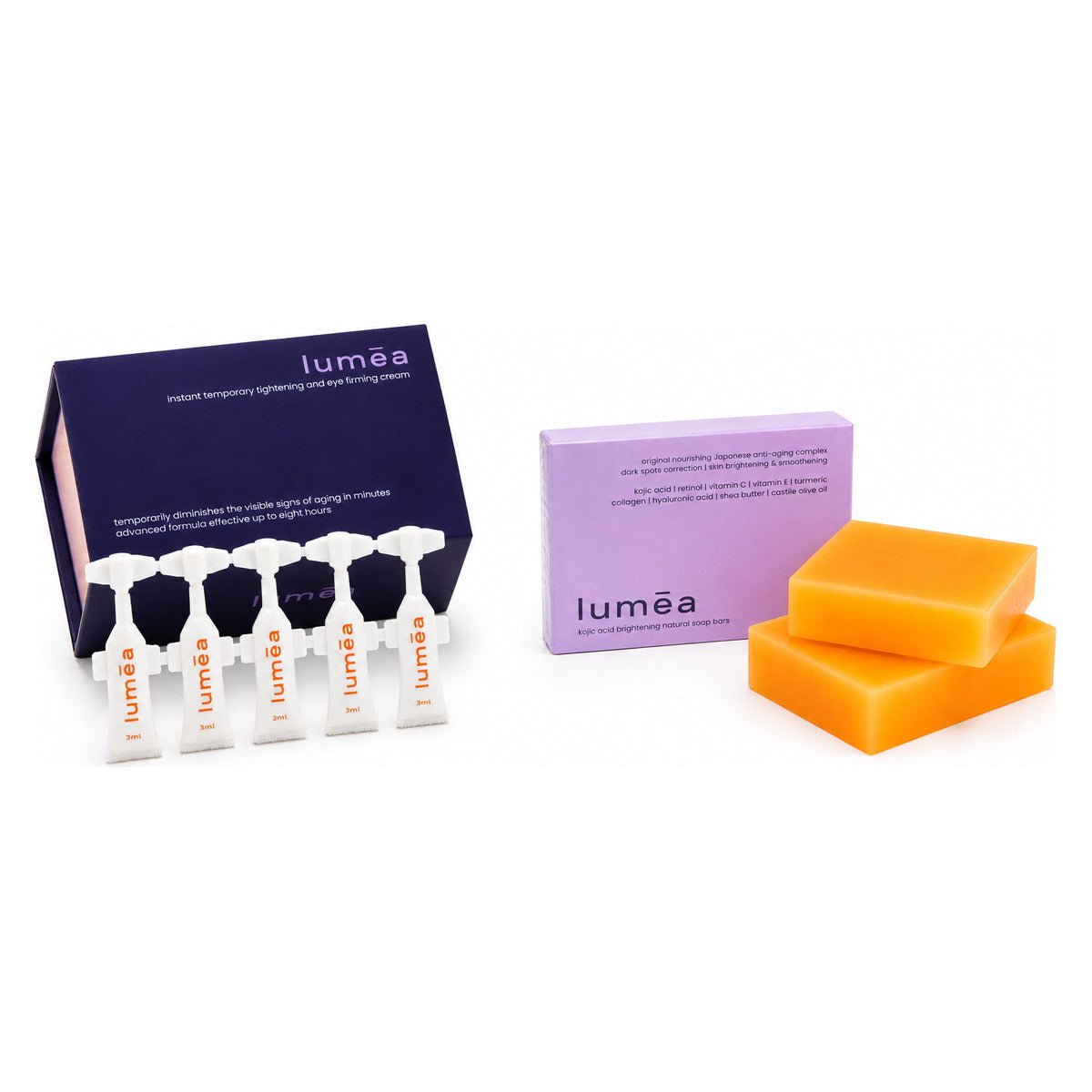
- Supporting ingredients that work on the same pathway. Vitamin C, retinol and niacinamide approach pigment from different angles, which is why the kojic acid bar in lumēa's Dark Spot Remover also carries retinol, vitamin C, vitamin E, turmeric and hyaluronic acid alongside shea butter and olive oil. If you are pregnant or breastfeeding, retinol is generally something to avoid — check with your doctor before using any product that contains it. Retinol can also cause dryness and irritation, so introduce it gradually rather than daily from day one.
- A stable routine you can actually keep. Rotating products every fortnight resets the clock. It helps to decide the whole thing once — there is a straightforward way to build a skincare routine around dark spots and then leave it alone.
What stalls it completely
- Unprotected sun exposure. The most common reason people conclude that kojic acid does not work. A single sunny weekend can undo weeks of progress.
- Picking and squeezing. Every bit of trauma to the skin risks leaving a new mark behind, so you end up replacing pigment as fast as you fade it.
- Over-exfoliating into irritation. This is the trap that catches motivated people. Inflammation is itself a trigger for pigment production, so an aggressive routine of acids, scrubs and strong actives can darken the exact spots you are chasing. If skin is stinging, red or flaking, the routine is going backwards.
- Leaving a cleansing bar on the skin to "boost" it. A cleanser is formulated for short contact. Lather on damp skin, leave it roughly thirty seconds, rinse. Leaving it on for minutes does not accelerate anything and reliably causes irritation.
- Skipping the patch test. Kojic acid can irritate, and a small number of people develop contact sensitivity to it. Test on a discreet patch of skin, such as the inner forearm, for a few days before using it on your face.
How to tell whether it is working
Daily mirror checks are useless for this. Change accumulates too slowly to register against a memory of yesterday, and bathroom lighting varies more than your skin does. Take a photograph on day one — same window, same time of day, no filter, no makeup — and repeat it once a month. Compare month one to month three, never day thirty to day thirty-one.
Judge it on the right terms. What a cosmetic routine delivers is spots that look lighter and skin tone that looks more even. It does not erase pigment, and any product promising that in two weeks is describing something other than how skin works.
If you have used it consistently with daily sunscreen for around three months and see absolutely no change, that is useful information rather than a reason to double the dose. It usually means the pigment sits deeper than a cosmetic product reaches, and a dermatologist has options that work at that depth. Separately, and as ordinary caution rather than alarm: any spot that appears suddenly, changes in size, shape or colour, has irregular edges, or is much darker than the rest should be looked at by a professional before you try to fade it.
Frequently asked questions
How long before I see anything at all?
Four to eight weeks for the first faint change, assuming daily use. Nothing meaningful can happen in the first month because your skin has not completed a full turnover cycle yet. If you want to stay motivated through that dead period, take the monthly photographs — they show progress your eyes cannot.
Can I speed it up by using it twice a day or leaving it on longer?
No. Leaving a cleansing bar on the skin does not increase the benefit and does increase the risk of irritation, and irritation can drive more pigment. Twice daily is fine for some people and too much for others; if skin feels tight or looks red, drop back to once a day or every other day. The lever that actually shortens the timeline is sunscreen, not frequency.
Why do my dark spots look darker after a few weeks?
Usually one of three things: sun exposure that outpaced the routine, irritation from too many actives at once, or seasonal change as the days get longer. A rinse-off cleanser does not cause pigment to surface or "purge", so darkening is a signal to check your SPF habit and simplify your routine rather than to push harder.
Will the spots come back if I stop using it?
Pigment that has already faded does not reappear on its own, but the conditions that created it are still there. Without ongoing sun protection, new pigment is produced and spots gradually return over months. Most people keep using a brightening cleanser two or three times a week as maintenance once they are happy with where they have landed.
Can I use kojic acid while pregnant or breastfeeding?
Ask your doctor, and read the full ingredient list rather than just the headline active. Many brightening products, including our own, pair kojic acid with retinol — and people who are pregnant or breastfeeding are generally advised to avoid retinol. Your doctor or midwife can tell you what is appropriate for your situation.
Does it fade body areas faster than the face?
Generally slower, not faster. Skin on elbows, knees, knuckles and underarms is thicker and turns over less quickly, so darkening in those areas typically needs longer and more patience than facial marks. The routine is the same: consistent daily cleansing, no scrubbing the area raw, and sunscreen on anything that sees daylight.